Introduction
In the modern enterprise, data has evolved into the primary driver of digital transformation. However, as the volume of information grows, many organizations find that their manual data management processes are failing to keep up. This creates a massive bottleneck that slows down software releases and compromises the accuracy of business intelligence. This is why the DataOps Certified Professional (DOCP) has become so essential. By applying the proven automation principles of DevOps to the data lifecycle, teams can ensure that information is treated as a high-quality, fast-moving asset. This guide is designed to help software engineers and technical managers understand the roadmap to mastering DataOps.
What is DataOps Certified Professional (DOCP)?
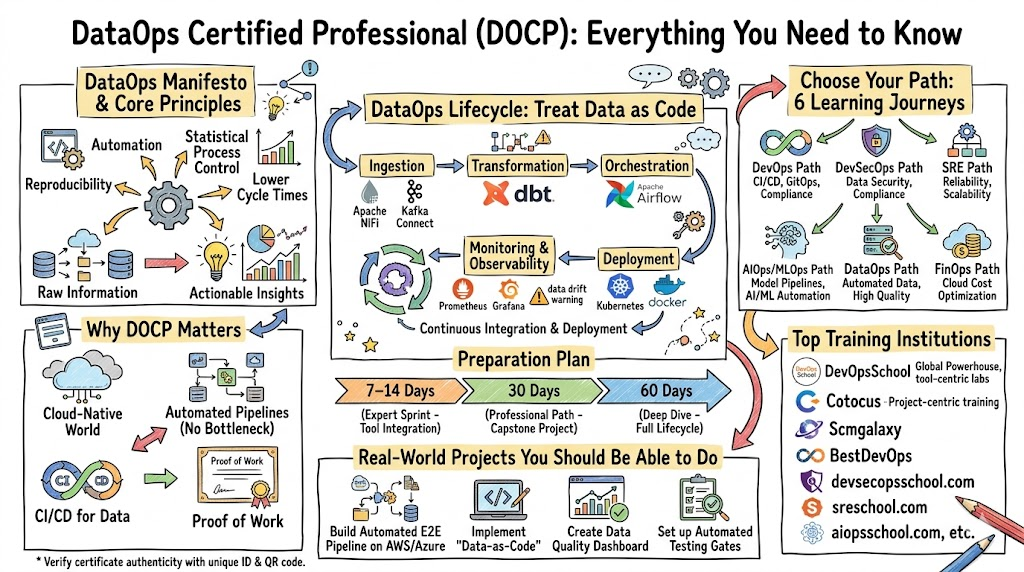
The DataOps Certified Professional (DOCP) is a specialized technical validation that focuses on the convergence of data engineering, automation, and operational stability. It is much more than a traditional database course; it is a holistic framework for managing the entire data supply chain. The DOCP program teaches professionals how to use the “Ops” mindset to eliminate data silos and automate complex transformations. It is built on the core principles of the DataOps Manifesto, which prioritizes the reduction of cycle time and the improvement of data quality.
By pursuing the DOCP, you prove that you can handle data as code. The certification covers the architecture of modern data stacks, including automated ingestion, real-time streaming, and continuous monitoring. It bridges the gap between the data scientists who need reliable insights and the IT operations teams who manage the underlying infrastructure. Ultimately, it turns a fragmented and manual data environment into a streamlined, self-healing production system that delivers value at the speed of the business.
Why it Matters in Today’s Software, Cloud, and Automation Ecosystem
In our current cloud-centric ecosystem, software is only as powerful as the data it utilizes. As businesses scale their platforms using Kubernetes, microservices, and serverless computing, the underlying data layer must remain equally agile. DataOps matters because it provides the orchestration and reliability required to support high-velocity environments. Without it, the data layer becomes a single point of failure that prevents organizations from fully realizing the benefits of cloud automation.
As the industry moves toward AIOps, MLOps, and real-time decision-making, the demand for clean and trustworthy data has skyrocketed. Manual data handling is no longer sustainable. The DOCP certification is vital because it equips engineers with the tools to build the automated “highways” for data. It ensures that data is consistently available, accurate, and secure, regardless of the scale. In a landscape where speed and precision are the ultimate competitive advantages, mastering DataOps is the key to maintaining a high-performance software ecosystem.
Why Certifications are Important for Engineers and Managers
For engineers, a certification like the DOCP is a definitive proof of technical maturity and specialized expertise. It provides a structured path to move beyond general coding and into the high-demand world of data automation. In a global job market, particularly in competitive regions like India, having a verified credential simplifies the recruitment process and helps engineers secure senior roles with significantly higher compensation. It demonstrates a commitment to mastering the most modern and impactful technical methodologies.
For managers, certifications serve as a strategic benchmark for evaluating team competency. When you lead a team of certified DOCP professionals, you ensure that every member adheres to the same set of high-quality standards and technical practices. This reduces the accumulation of technical debt and minimizes the risk of costly production incidents. For leadership, fostering a certified workforce builds a culture of excellence. It ensures the organization is ready to handle the complexities of 2026 and beyond, making it much easier to meet aggressive delivery goals and maintain system reliability.
Why Choose DevOpsSchool?
Choosing the right training partner is essential for mastering complex domains like DataOps. DevOpsSchool has built a global reputation as a premier provider of high-end technical training. What sets them apart is their practitioner-centric approach. They do not just teach the theory of automation; they provide intensive, hands-on lab experiences that reflect real-world production challenges. Their curriculum is designed by industry veterans who understand the daily hurdles faced by SREs and data engineers.
At DevOpsSchool, students gain access to a complete learning ecosystem. This includes a dynamic Learning Management System (LMS) with lifetime updates, 24/7 technical support, and a massive network of global alumni. Their focus on “Tool-Centric” learning ensures you aren’t just reading about data pipelines—you are actually building and breaking them in a safe, mentored environment.
Certification Deep-Dive: DataOps Certified Professional (DOCP)
What is this certification?
The DataOps Certified Professional (DOCP) is a professional-level credential that validates your ability to manage the entire data delivery lifecycle. It focuses on the concept of “Data as Code,” teaching you how to apply version control, continuous integration, and automated testing to data pipelines. The program moves beyond simple database management to explore the orchestration of complex workflows using modern automation tools. You will learn how to apply agile methodologies to data delivery, ensuring your organization can respond to changing business needs with speed and high confidence.
Who should take this certification?
This certification is tailor-made for Data Engineers, Database Administrators (DBAs), and DevOps specialists who want to lead data-centric transformations. It is also an excellent choice for Site Reliability Engineers (SREs) who are increasingly responsible for the uptime and performance of data platforms. Software Engineers looking to transition into data-centric roles will find this program to be a vital bridge. Additionally, Engineering Managers who need to oversee the technical implementation of data strategies will find the DOCP curriculum essential for guiding their teams.
Certification Overview Table
| Track | Level | Who it’s for | Prerequisites | Skills Covered | Recommended Order |
| DataOps | Professional | Engineers & Managers | Basic IT & SQL | CI/CD for Data, Kafka, Airflow | After DevOps Master |
DataOps Certified Professional (DOCP) Details
What it is
A specialized technical certification focusing on the integration of data engineering, automation, and operational monitoring to build high-velocity data pipelines.
Who should take it
Working software engineers, data leads, and cloud operations specialists who manage data-intensive infrastructures.
Skills you’ll gain
- Building and managing automated data delivery pipelines.
- Mastery of orchestration platforms like Apache Airflow and NiFi.
- Implementation of real-time data streaming and processing using Kafka.
- Managing data infrastructure as code with Terraform and Docker.
- Designing automated data quality gates and validation testing protocols.
- Applying CI/CD principles specifically to data transformations using dbt.
Real-world projects you should be able to do
- Construct a fully automated end-to-end data pipeline on a major cloud provider.
- Implement a “Data as Code” workflow using version control and containerization.
- Build a real-time monitoring dashboard for data quality and latency using Grafana.
- Set up an automated alerting system to identify and fix data drift in production.
Preparation Plan
7–14 Days (The Expert Sprint)
- Focus on the core principles of the DataOps Manifesto and agile data culture.
- Spend 4 hours daily on hands-on tool integration with Kafka and Airflow.
- Review common failure patterns in data pipelines and their automated fixes.
- Take multiple full-length practice exams to gauge your timing and accuracy.
30 Days (The Professional Path)
- Week 1: Master the concepts of version control for data and environment parity.
- Week 2: Deep dive into data ingestion, storage, and streaming architectures.
- Week 3: Focus on transformation (dbt) and orchestration (Airflow/Dagster).
- Week 4: Implement security, monitoring, and complete your final capstone project.
60 Days (The Mastery Track)
- Month 1: Solidify foundations in Linux, Python for data, and SQL performance tuning.
- Month 2: Gradually build and automate each stage of a complex data pipeline from scratch.
- Final 2 Weeks: Focused study on the most complex exam scenarios and mock tests.
Common Mistakes to Avoid
- Focusing only on the tools: Tools change, but the DataOps mindset is what truly matters.
- Ignoring Data Quality: Moving data faster is useless if the data itself is inaccurate or broken.
- Lack of Hands-on Practice: You cannot pass the DOCP through reading; you must spend time in the terminal.
- Underestimating Culture: DataOps requires breaking down team silos; don’t ignore the collaborative aspect.
Best Next Certification after this
MLOps Certified Professional (to lead the automation of AI and Machine Learning lifecycles).
Choose Your Path: 6 Learning Journeys
- DevOps Path: Focus on the broad culture of automation, bridging the gap between developers and IT operations for faster software releases.
- DevSecOps Path: Prioritize security-first pipelines, integrating automated vulnerability scanning and compliance checks into every stage.
- SRE Path: Learn the art of keeping high-scale systems healthy, focusing on availability, scalability, and error budget management.
- AIOps/MLOps Path: Combine the power of AI with operations to create self-healing systems and automated model lifecycles.
- DataOps Path: Concentrate on the flow and quality of data, ensuring it remains a trusted and fast-moving asset for the company.
- FinOps Path: Master the financial side of cloud infrastructure, learning how to balance technical performance with budget optimization.
Role → Recommended Certifications Mapping
| Your Current Role | Recommended Certification Journey |
| DevOps Engineer | DevOps Master → DOCP → SRE Practitioner |
| SRE | SRE Certified Professional → DOCP → AIOps Specialist |
| Platform Engineer | CKA (Kubernetes) → DOCP → Cloud Architect |
| Cloud Engineer | AWS/Azure Admin → DOCP → DevSecOps Professional |
| Security Engineer | DevSecOps Master → DOCP (Focus on Data Security) |
| Data Engineer | DOCP → MLOps Professional → Data Scientist |
| FinOps Practitioner | FinOps Professional → DOCP (for Data Cost Management) |
| Engineering Manager | DOCP → Tech Leadership → SRE for Managers |
Next Certifications to Take
- Same Track (Deepening Skills):
- MLOps Certified Professional: Extend your pipeline skills to automate machine learning workflows.
- Big Data Professional: Master the handling of massive-scale distributed storage and processing.
- Cross-Track (Broadening Skills):
- DevSecOps Professional: Learn to secure the entire data pipeline against breaches and leaks.
- SRE Certified Professional: Gain the skills to manage the uptime and performance of data platforms.
- Leadership (Advancing Your Career):
- Technical Program Manager: Focus on leading large-scale, cross-functional engineering initiatives.
- Cloud Solutions Architect: Master the high-level design of multi-cloud data and app ecosystems.
Top Training Institutions for DOCP
- DevOpsSchool: This is the primary destination for DOCP training. They offer a comprehensive, tool-heavy curriculum that is recognized globally. Their instructors are industry experts who provide deep insights into real-world data challenges and offer lifetime career support. They are the market leaders in technical certifications for India and global markets.
- Cotocus: Known for their hands-on, consulting-led approach. They provide excellent practical scenarios where students can build and break data pipelines, making it ideal for those who learn best by doing. Their training style is focused on enterprise-level problem solving.
- Scmgalaxy: A long-standing community for configuration management and automation. They offer specialized tracks that focus on the version control and “Data as Code” aspects of the curriculum, ensuring students master the fundamentals of modern data delivery.
- BestDevOps: Focuses on intensive bootcamps designed to get you certified quickly. Their curriculum is highly focused on the most critical skills needed to pass the exam on the first attempt while maintaining high technical standards.
- devsecopsschool.com: If you want to master the security side of DataOps, this is the place to go. They integrate security audits and compliance checks into the heart of the data pipeline training to ensure secure and compliant data delivery.
- sreschool.com: This institution focuses on data reliability. They teach you how to apply SRE principles—like SLIs and SLOs—specifically to data platforms to ensure maximum performance and availability for enterprise data sets.
- aiopsschool.com: Perfect for those moving from DataOps into the future of AI-driven operations. They provide advanced courses on automating data for intelligent decision-making and creating self-healing data environments.
- dataopsschool.com: A dedicated portal that specializes exclusively in the DataOps domain. They offer the most specialized curriculum for professionals looking to become absolute experts in this specific technical niche.
- finopsschool.com: Essential for those who need to manage the cost of data. They teach you how to build high-performance pipelines that don’t break the company’s cloud budget, focusing on cloud financial accountability.
FAQs (General Career & Certification)
How much time is needed to prepare for the DOCP?
Most professionals with a basic technical background can be ready within 4 to 6 weeks of dedicated study.
Is there a lot of coding in the DOCP?
Yes, you should be comfortable with Python and SQL, as these are the primary languages for automating data tasks.
What is the difference between Data Engineering and DataOps?
Data Engineering builds the pipeline, while DataOps ensures the pipeline is automated, monitored, and reliable at scale.
Is this certification valuable in the Indian market?
Absolutely. India’s tech sector is rapidly adopting DataOps, and certified professionals are in high demand across all major MNCs.
Does the DOCP certification expire?
Generally, the certificate is valid for a lifetime, but staying updated with new tool versions every few years is recommended.
Can I take the exam online?
Yes, the certification exams are typically proctored online, allowing you to take them from any location globally.
Are there any prerequisites for the DOCP?
While not strictly mandatory, a basic understanding of cloud computing and Linux commands will make the labs much easier.
How does DataOps relate to DevOps?
DataOps is the application of DevOps principles—like CI/CD and automation—specifically to the challenges of data management.
Does the course cover cloud tools like Snowflake or Redshift?
Yes, the curriculum includes how to integrate these popular cloud data warehouses into a modern DataOps workflow.
What is the passing score for the DOCP exam?
The passing score is usually 70%, which requires a solid grasp of both theoretical concepts and practical lab exercises.
Do I receive a digital badge after certification?
Yes, most providers issue a verifiable digital badge and certificate that you can easily share on LinkedIn and your resume.
Is there job placement support provided?
Top institutions like DevOpsSchool offer career kits, resume reviews, and access to their massive alumni network for job leads.
FAQs (DataOps Certified Professional – DOCP)
Is the DOCP certification cloud-specific?
No, it is cloud-agnostic, meaning the skills you learn can be applied to AWS, Azure, Google Cloud, or on-premise setups.
How much of the training is hands-on?
Expect about 60-70% of your training time to be spent on practical lab exercises and building real-world projects.
Does the certification cover Big Data tools?
Yes, you will work with core Big Data ecosystem tools such as Apache Kafka, Spark, and various orchestration engines.
Is there a focus on Data Privacy and Security?
Yes, security is a core component. You will learn how to build automated pipelines that are compliant with global privacy laws.
What kind of technical support is available?
Most training providers offer 24/7 technical support and direct access to instructors during the lab phases.
Can I apply for the exam without attending a formal course?
While possible, it is highly recommended to go through a certified training provider to understand the practical lab scenarios.
What is the format of the DOCP exam?
The exam consists of a mix of multiple-choice questions and scenario-based technical problems that test your practical knowledge.
How often is the DOCP curriculum updated?
The curriculum is typically reviewed and updated annually to stay in sync with the latest releases in the DataOps toolchain.
Conclusion
The transition of data from a static resource into a high-velocity automated stream represents the most significant shift in the modern technical industry. Having navigated the complexities of systems administration and platform engineering for over two decades, I have observed many trends, but the move toward DataOps is a fundamental change in how software is built. Mastering the DataOps Certified Professional (DOCP) curriculum is more than just obtaining a credential; it is about adopting a mindset that prioritizes reliability, speed, and quality.
Whether you are an engineer looking to future-proof your career or a manager aiming to build a resilient team, this certification provides the essential framework to succeed in a cloud-native ecosystem. By bridging the gap between raw data and actionable intelligence, you become an indispensable asset to your organization. Start your certification journey today and lead the next wave of the data revolution in the global market.