Introduction
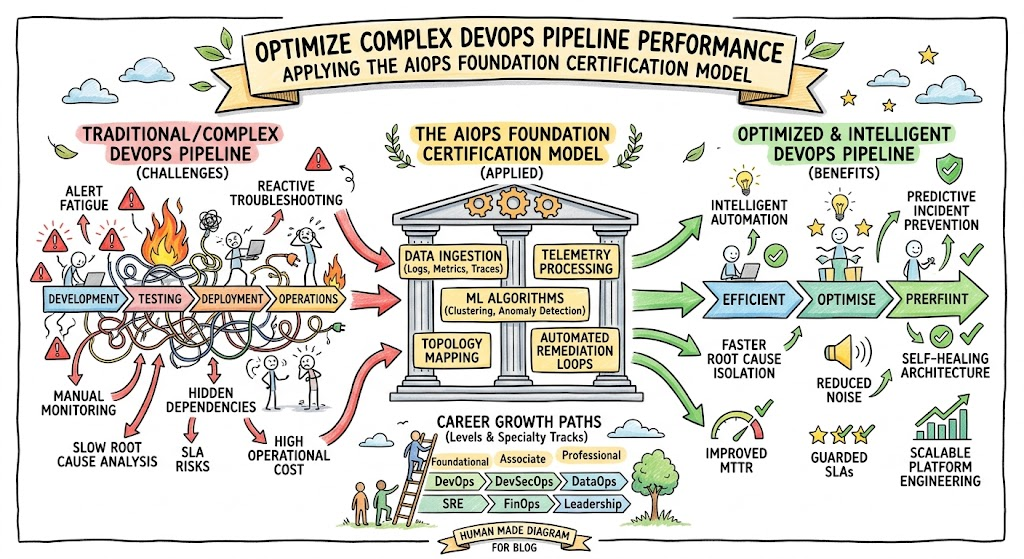
Distributed software platforms generate massive volumes of telemetry data across diverse cloud environments every single minute. Traditional operations frameworks struggle to analyze these firehoses of logs, traces, and metrics efficiently. This analytical bottleneck regularly causes widespread alert fatigue, extended troubleshooting delays, and unpredictable systems downtime for global enterprises. Engineering organizations need a modern, data-driven methodology to process operational signals automatically and maintain platform stability.
The AIOps Foundation Certification establishes a comprehensive educational framework that directly solves these massive data scale challenges. Through specialized programs hosted on AiOpsSchool, infrastructure practitioners learn how to embed machine learning logic directly into live application telemetry loops. This credential systematically bridges the historical divide between core data science and day-to-day site reliability operations. This guide empowers engineers and managers to make strategic career decisions by thoroughly breaking down the certification layout.
What is the AIOps Foundation Certification?
This professional credential represents an industry-validated curriculum that emphasizes the integration of data science mechanisms into modern IT operations pipelines. It focuses entirely on building resilient telemetry systems that ingest, parse, and analyze massive enterprise datasets in real time. Instead of emphasizing abstract mathematical theories, the course material prioritizes hands-on validation in active production-grade setups. Engineers learn how to replace static, fragile alert scripts with dynamic machine learning algorithms that understand system context.
The curriculum matches the practical demands of modern platform engineering and cloud-native application deployments perfectly. It defines a standardized approach to manage high-velocity telemetry streams across multi-cloud setups smoothly. Organizations utilize this framework to build a robust data-driven operational culture within their technology departments. Ultimately, this program confirms that an engineering professional possesses the skills to architect autonomous infrastructure pipelines.
Who Should Pursue AIOps Foundation Certification?
Site Reliability Engineers, infrastructure developers, and system operators who manage complex distributed deployments gain immediate value from this curriculum. Cloud architects and database administrators also require these specific analytical skills to maintain application uptime effectively. The educational roadmap serves multiple professional levels, welcoming junior developers seeking baseline knowledge alongside senior principals designing enterprise platforms. Technical leaders and engineering managers use this framework to design modern team structures and guide software automation initiatives.
Technology professionals across global tech hubs and India’s rapidly expanding enterprise software ecosystem actively seek this validation to stand out. As Indian IT service organizations pivot from legacy infrastructure maintenance toward intelligent platform engineering, developers need verified machine learning operations expertise. This credential provides a clear competitive edge in high-stakes hiring markets by proving your ability to handle massive production scale. It gives technical specialists the precise vocabulary they need to lead automation projects inside modern engineering groups.
Why AIOps Foundation Certification is Valuable
Software tools and cloud providers evolve constantly, but the foundational architecture of data pipelines remains highly consistent over time. This certification delivers long-term career durability by teaching core mathematical concepts, pattern recognition, and stream correlation patterns instead of proprietary vendor dashboards. Engineers who master these techniques reduce system outage durations dramatically, saving corporations thousands of dollars in operational costs. This immediate financial and operational impact makes certified individuals highly visible assets within their respective companies.
Enterprise organizations rapidly accelerate their adoption of intelligent automation systems to manage soaring telemetry storage expenses. Holding this credential confirms your readiness to spearhead these high-impact technical and financial optimization strategies. It provides a reliable shield against professional stagnation by anchoring your expertise in universal, high-value architectural principles. Investing your time into this learning curriculum yields immediate returns through enhanced technical execution and expanded leadership opportunities.
AIOps Foundation Certification Overview
The learning journey presents an immersive digital experience that combines deep conceptual lectures with rigorous laboratory assignments. Students access the program curriculum through the AIOps Foundation Certification training catalog hosted on aiopsschool.com to build practical skills. This methodology balances technical explanations with direct engineering experiments using live container clusters and telemetry generators. This dual approach ensures that candidates master both the statistical logic and the actual implementation mechanics.
The evaluation process verifies practical competency by testing real-world incident resolution and system design scenarios. The curriculum maintains alignment with open observability initiatives like OpenTelemetry alongside major enterprise monitoring suites. This comprehensive focus prepares candidates to step directly into production environments and add immediate value. Technical executives highly respect this educational program because it prioritizes engineering truth over vendor marketing points.
AIOps Foundation Certification Tracks & Levels
The educational architecture divides engineering competencies into three structured tiers to support continuous professional development. The Foundational Level targets core data ingestion patterns, basic telemetry structures, and baseline statistical anomaly rules. This starting phase gives junior professionals or testers a clear understanding of data-driven infrastructure principles. It builds the necessary mental models before students progress to complex automation configurations.
The Associate Level introduces advanced engineering mechanics, including log clustering algorithms, natural language processing patterns, and event correlation matrices. Engineers at this stage learn to write automated self-healing scripts that react directly to live anomaly notifications. Finally, the Professional Level challenges senior architects to design multi-cloud streaming telemetry planes and predictive resource management workflows. This progressive tiering ensures that technical experts expand their capabilities in sync with their career growth.
Complete AIOps Foundation Certification Table
The following matrix outlines the strategic progression paths across the validation ecosystem.
| Track | Level | Who it’s for | Prerequisites | Skills Covered | Recommended Order |
| Platform Analytics | Foundational | Systems Operators, Test Automation Specialists | Linux Command Basics, Core Infrastructure Understanding | Telemetry Management, Ingestion Setup, Signal Baselines | First Phase |
| Incident Orchestration | Associate | DevOps Practitioners, SRE Specialists | Foundational Level Completion, Basic Automation Scripting | Log Clustering, Event Aggregation, Remediation Workflows | Second Phase |
| Enterprise Architecture | Professional | Principal Engineers, Infrastructure Leads | Associate Level Mastery, Distributed Systems Experience | Cross-Cloud Data Planes, Predictive Resource Management | Third Phase |
Detailed Guide for Each AIOps Foundation Certification
Foundational Level
AIOps Foundation Certification – Core Foundation
What it is
This certification validates an engineer’s capability to establish basic telemetry collection pipelines and configure fundamental statistical anomaly alerts. It proves that the candidate understands how data flows from application nodes to centralized monitoring frameworks.
Who should take it
Junior systems administrators, entry-level cloud engineers, and quality assurance testers who want to transition into automated infrastructure operations should complete this course.
Skills you’ll gain
- Deploy open-source metric collection agents across distributed Linux environments safely.
- Establish dynamic baseline calculations for core application performance data streams.
- Filter out redundant infrastructure notifications to minimize team alert fatigue.
Real-world projects you should be able to do
- Build a functional, centralized logging pipeline that collects and organizes telemetry from a distributed application.
- Configure dynamic alerting rules that adjust threshold settings automatically based on historical traffic patterns.
Preparation plan
- 7-14 Days: Review core observability terminology and study standard time-series data structures thoroughly.
- 30 Days: Complete all fundamental video training courses and practice configuring collectors in local lab setups.
- 60 Days: Take realistic practice examinations to locate knowledge gaps and refine data filtering configurations.
Common mistakes
Candidates often waste time memorizing complex mathematical data science algorithms instead of focusing on practical telemetry configuration mechanics. Many individuals also neglect basic operating system configurations, which undermines their ability to deploy collection software.
Best next certification after this
- Same-track option: AIOps Foundation Certification – Certified Associate Specialist
- Cross-track option: Site Reliability Engineering Advanced Automation Practitioner
- Leadership option: Technical Platform Project Manager Certification
Associate Level
AIOps Foundation Certification – Certified Associate Specialist
What it is
This qualification confirms an engineer’s ability to implement advanced log clustering, execute heuristic event correlation, and build automated incident response pipelines. It certifies practical execution skills in high-velocity production data environments.
Who should take it
Mid-level DevOps practitioners, active SREs, and platform administrators who manage live corporate workloads require this intermediate milestone.
Skills you’ll gain
- Apply natural language processing models to group unstructured system log streams automatically.
- Design event correlation rules that bundle separate alerts into single, clear incident reports.
- Program automated remediation playbooks that execute self-healing steps during infrastructure anomalies.
Real-world projects you should be able to do
- Launch an automated self-healing framework that triggers container restarts when log anomaly patterns emerge.
- Construct an active event correlation matrix that groups network, database, and computing alerts during simulated outages.
Preparation plan
- 7-14 Days: Study advanced log parsing strategies and analyze standard event correlation formulas.
- 30 Days: Build complete automation loops in isolated staging environments using API integrations and script runners.
- 60 Days: Evaluate complex enterprise outage case studies and complete intensive scenario-based mock tests.
Common mistakes
Engineers frequently deploy automated recovery workflows without establishing strict safety limits or manual override pathways. They also fail to deduplicate raw telemetry streams, which rapidly saturates script processing nodes.
Best next certification after this
- Same-track option: AIOps Foundation Certification – Professional Solutions Architect
- Cross-track option: DevSecOps Security Intelligence and Automated Compliance Specialist
- Leadership option: Infrastructure Technical Product Manager
Professional/Specialty Level
AIOps Foundation Certification – Professional Solutions Architect
What it is
This advanced credential verifies an architect’s capacity to design multi-cloud telemetry frameworks, deploy predictive scaling architectures, and implement automated cost-control engines.
Who should take it
Principal infrastructure engineers, senior cloud architects, and technology directors who drive enterprise-wide technical strategy should pursue this expert-tier certification.
Skills you’ll gain
- Architect high-throughput real-time streaming data layers across complex multi-cloud deployments.
- Deploy production-ready machine learning inference models optimized specifically for large-scale infrastructure data.
- Align runtime performance data directly with business financial KPIs and corporate infrastructure budgets.
Real-world projects you should be able to do
- Design a predictive maintenance platform that forecasts enterprise hardware resource exhaustion weeks before it occurs.
- Implement an autonomous cost-management framework that downscales multi-region cloud resources safely during low-demand periods.
Preparation plan
- 7-14 Days: Analyze complex enterprise system topologies and evaluate global corporate data governance rules.
- 30 Days: Outline multi-cloud streaming architectures and create detailed blueprints for unified data planes.
- 60 Days: Study model drift mitigation strategies and design comprehensive organizational change management plans.
Common mistakes
Architects regularly focus completely on building technical systems while ignoring organizational transparency and operational trust factors. This oversight results in highly complex automation tools that operations teams refuse to activate in production.
Best next certification after this
- Same-track option: Principal Infrastructure Fellow Distinction
- Cross-track option: FinOps Strategic Cloud Financial Advisor
- Leadership option: Director of Infrastructure and Platform Engineering
Choose Your Learning Path
DevOps Path
Practitioners following this strategy integrate automated performance models directly into continuous integration and delivery pipelines. They focus on identifying code regressions immediately after a deployment before bugs impact downstream customers. This pathway transforms standard deployment pipelines into self-correcting systems that constantly improve overall software delivery speed.
DevSecOps Path
Security specialists use anomaly detection engines to uncover malicious user patterns hidden inside massive production log repositories. This learning track coordinates traditional infrastructure metrics with real-time audit logs to expose zero-day vulnerabilities early. Candidates learn to replace slow, manual compliance audits with continuous, code-driven security verification loops.
SRE Path
Site Reliability Engineers employ algorithmic workflows to protect system error budgets and automate initial incident triage work. This path substitutes rigid, human-configured thresholds with multi-variate statistical models that adapt to real-time workload changes. The strategy allows engineers to eliminate repetitive operational toil and protect their schedules for deep architectural design.
AIOps Path
This specialized curriculum concentrates entirely on the stability, capacity, and performance of large-scale operational ingestion fabrics. Experts learn to manage high-cardinality data pipelines, stream-processing layers, and time-series database optimizations during intense outages. The track ensures that core automated data collection networks survive sudden, massive spikes in infrastructure telemetry.
MLOps Path
Engineers on this pathway handle the unique operational requirements of deploying and tracking machine learning models in production environments. They construct automated data validation loops, track feature store histories, and identify model accuracy drops over time. This track guarantees that intelligent deployment frameworks remain completely accurate as the underlying application architecture changes.
DataOps Path
Data management experts use this operational framework to introduce continuous integration and automation principles to enterprise data pipelines. They build monitoring loops that verify data quality, trace schema evolutions, and coordinate large-scale data lake expansions. This path establishes highly resilient data infrastructure that feeds clean operational insights to corporate analytics systems.
FinOps Path
Cloud financial managers leverage predictive analytics models to forecast corporate spending and eliminate infrastructure resource waste automatically. This track connects cloud billing dashboards directly with live system utilization data to automate resource resizing actions. It empowers technical teams to enforce strict financial limits without lowering application responsiveness or user experience.
Role → Recommended AIOps Foundation Certification Certifications
The following table matches specific professional positions with their ideal educational milestones.
| Role | Recommended Certifications |
| DevOps Engineer | Foundational Level, Associate Event Automation Track |
| SRE | Associate Event Automation, Professional Specialty Architecture |
| Platform Engineer | Foundational Level, Professional Specialty Architecture |
| Cloud Engineer | Foundational Level, Associate Event Automation Track |
| Security Engineer | Foundational Level, DevSecOps Security Intelligence Specialty |
| Data Engineer | Foundational Level, DataOps Infrastructure Track |
| FinOps Practitioner | Foundational Level, FinOps Cost Optimization Specialty |
| Engineering Manager | Foundational Level, Leadership Option Tracks |
Next Certifications to Take After AIOps Foundation Certification
Same Track Progression
Advancing directly through the higher tiers of this certification ecosystem proves your comprehensive technical mastery to global enterprises. Moving systematically from basic data collection to advanced system architecture demonstrates a complete grasp of modern automated operations. This direct progression confirms that you can guide an automation project from the initial ingestion setup to multi-cloud deployment.
Cross-Track Expansion
Broadening your technical expertise across adjacent operational tracks builds a highly versatile profile capable of solving multi-departmental issues. Combining core analytical skills with specialized certificates in cloud finance, data pipelines, or security engineering makes you extraordinarily competitive. This method helps you act as a crucial technical bridge between separate infrastructure, compliance, and budget teams.
Leadership & Management Track
Shifting toward organizational management requires you to move from writing code to defining long-term corporate automation strategies. This curriculum teaches senior engineers how to handle technology vendor selections, structure modern technical teams, and justify infrastructure investments. It completely prepares professionals to assume influential executive positions like Director of Platform Engineering or Head of SRE.
Training & Certification Support Providers for AIOps Foundation Certification
- DevOpsSchool offers immersive, instructor-led training blueprints that help engineers master modern infrastructure automation frameworks. Their comprehensive educational courses provide extensive sandboxed laboratory setups where students actively troubleshoot simulated enterprise system failures and configure telemetry collection agents. The curriculum receives frequent updates to match evolving corporate hiring standards and certification exam requirements perfectly, ensuring that candidates pass their tests smoothly.
- Cotocus specializes in high-tier technical training programs that target production-grade cloud architectures and continuous software delivery pipelines. Their educational approach highlights detailed, real-world corporate case studies, giving technical teams clear insights into successful automation deployments and pipeline scaling. They provide extensive mentorship support networks and guided lab sessions to help professionals master complex operational data analysis mechanisms quickly.
- Scmgalaxy hosts a vibrant global knowledge community and training platform that provides detailed technical tutorials for configuration management systems. Their targeted courses show students exactly how to convert manual infrastructure setups into version-controlled, automated code repositories. The platform serves as an excellent career accelerator for traditional systems administrators transitioning into modern automated platform engineering roles.
- BestDevOps produces highly practical, experience-driven education programs designed specifically for active systems administrators and cloud deployment specialists. Their training modules emphasize realistic execution patterns, helping students avoid critical configuration mistakes within live production environments during high-stress scenarios. The program includes structured study maps and rigorous mock examination engines to maximize student certification success rates globally.
- devsecopsschool.com provides specialized training tracks that focus entirely on embedding automated security verification gates into rapid software delivery pipelines. Their lessons teach infrastructure professionals how to translate complex compliance guidelines into active, automated code checks that scan code at scale. This targeted training helps engineers protect distributed container deployments within highly regulated corporate enterprise environments effectively.
- sreschool.com hosts advanced learning curricula built entirely around the core operational pillars of modern site reliability engineering practices. Their material covers deep metric alert consolidation strategies, error budget tracking mechanics, and the design of highly resilient self-healing server networks. Students engage with realistic infrastructure failure simulators to prepare thoroughly for intense, real-world production support engineering responsibilities.
- aiopsschool.com leads the education market as a dedicated training venue focused entirely on merging machine learning concepts with IT operations. Their structured certification tracks empower engineers to deploy predictive analytics engines and intelligent data processing systems across diverse business environments. The training matches data science fundamentals perfectly with hands-on, production-grade cloud platform engineering lab work.
- dataopsschool.com delivers targeted technical instruction aimed at modernizing enterprise data delivery networks and establishing rigorous data reliability standards. Their training tracks apply continuous integration principles directly to data lake management, data warehousing setups, and large-scale analytical processing engines. The platform helps data engineers construct stable, high-throughput pipelines that feed clean telemetry data to corporate analytical systems.
- finopsschool.com focuses exclusively on the critical intersection of cloud system architecture, financial corporate governance, and automated cost optimization strategies. Their targeted training blocks show engineers how to build automated monitoring loops that track and adjust cloud resource consumption patterns continuously. This specialized education enables technical professionals to maximize cloud efficiency while maintaining strict corporate budget limits easily.
Frequently Asked Questions
1. Which concrete operational changes occur within an engineering team after adopting this framework?
Teams shift completely from manual, reactive incident troubleshooting to proactive runtime orchestration driven by automated anomaly detection systems.
2. How do these technical courses handle the challenges of multi-cloud telemetry ingestion?
The curriculum teaches engineers how to standardize diverse data formats into a unified cloud-agnostic data plane using OpenTelemetry standards.
3. What programming language proficiency do candidates require to complete the labs successfully?
A baseline understanding of Python scripting and shell programming provides sufficient preparation for all intermediate and advanced lab modules.
4. Why should an engineering manager prioritize this validation for their infrastructure staff?
It ensures that the entire engineering department utilizes a unified operational vocabulary and designs systems using validated automation patterns.
5. How long does the foundational certificate remain valid before requiring renewal?
The credential maintains industry validity for a duration of three years, after which professionals complete continuing education blocks.
6. Can quality assurance automation engineers transition into SRE roles via this track?
Yes, the curriculum provides software testers with the exact data pipeline and systems engineering competencies that modern SRE positions require.
7. What metric determines the concrete business value of completing this training?
Organizations observe a sharp drop in Mean Time to Resolution and a major reduction in overall cloud infrastructure spend.
8. Does the exam process penalize candidates for failing the practical lab segment?
Yes, candidates must achieve passing scores on both the conceptual questions and the practical scenario-based troubleshooting lab challenges.
9. How does this training program approach the problem of persistent alert fatigue?
It teaches developers to deploy heuristic event correlation patterns that condense thousands of noisy warnings into single actionable incidents.
10. What specific background knowledge accelerates a student’s learning speed during this course?
Prior experience with Docker container environments, Kubernetes orchestration, and basic Linux systems administration speeds up conceptual comprehension immensely.
11. Do global enterprise employers recognize this specialized cloud-neutral credential?
Yes, top-tier technology firms and global service providers validate this certificate during their technical talent evaluation processes.
12. How often does the academic board update the practical laboratory datasets?
The technical committee refreshes the operational data samples quarterly to mirror the latest real-world enterprise application failure patterns.
FAQs on AIOps Foundation Certification
1. How do automated ingestion systems configured under this curriculum handle high-cardinality metadata processing during a sudden container cluster failure?
The training teaches engineers to deploy distributed stream processing networks that parse and aggregate high-cardinality metadata right at the collection source before it reaches the central database layer. This strategy stops time-series databases from experiencing severe write-loop blockages when thousands of containers restart simultaneously during an outage. Specialists learn to build ingestion paths that compress repetitive metrics while preserving critical debugging signals. This approach protects monitoring platform stability and guarantees that site reliability engineers receive clear, actionable root-cause insights within seconds of an incident, even under massive data loads.
2. In what way does the curriculum enable developers to convert unstructured application log files into structured, algorithmically readable data arrays?
Candidates learn to implement natural language processing models that read raw, unstructured log entries and group them automatically based on structural similarity. The course outlines specific log clustering patterns that strip out dynamic variables like timestamps or user IDs, leaving the core error message text intact. This process allows automation platforms to spot brand-new failure patterns instantly without requiring engineers to pre-write custom regex rules for every possible log variation. It turns traditional manual log analysis into a proactive, machine-driven discovery pipeline that identifies hidden application errors immediately.
3. Why do technology corporations across the Indian IT sector prioritize job candidates who hold this specific algorithmic operations credential?
As major technology service firms throughout India transition from labor-intensive infrastructure management to automated platform engineering models, basic scripting skills no longer suffice. This certification provides verified proof that a technical professional can design high-value automation projects that lower enterprise operational overhead and optimize cloud performance. It grants engineers access to premium product engineering roles, international architecture assignments, and advanced site reliability positions. The credential validates that a candidate possesses the systems engineering depth required to manage complex cloud operations for large global clients.
4. How does the certification material prepare system architects to manage and mitigate the risks of machine learning model drift over time?
The curriculum outlines detailed strategies for setting up continuous evaluation loops that measure model prediction accuracy directly against actual system states. Architects learn to detect data drift early, which occurs when application software updates or structural infrastructure modifications render older training datasets obsolete. The coursework provides step-by-step blueprints for launching automated retraining pipelines that collect fresh production telemetry data safely without interrupting active monitoring services. This methodology ensures that anomaly detection systems maintain high precision and dependability across years of continuous software development and architectural evolution.
5. Which exact mechanisms does the training provide to help platform engineering groups identify and eliminate hidden public cloud financial waste?
The framework trains technical professionals to link cloud billing APIs directly with real-time infrastructure utilization data streams to uncover idle resources. Engineers learn to deploy predictive analytics engines that forecast future workload demands and automate instance resizing actions ahead of time. The course details how to locate unattached storage volumes, optimize database caching layers, and automate the shutdown of non-production environments during off-peak hours. These practical techniques secure immediate, lasting drops in corporate cloud expenditure without reducing overall application performance or threatening consumer-facing service level agreements.
6. Why does this professional curriculum emphasize vendor-neutral open-source observability standards rather than specific proprietary enterprise monitoring tools?
Relying heavily on a single closed monitoring tool restricts an engineer’s career mobility and exposes enterprise organizations to severe vendor lock-in risks. This certification focuses on teaching universal telemetry processing concepts, stream correlation logic, and automated remediation patterns that apply to any cloud environment. Certified professionals can adapt their skills instantly to work with open-source tools like Prometheus or enterprise platforms like Datadog. This foundational focus ensures that your technical skill set remains highly valuable to any enterprise employer, regardless of their specific tooling choices.
7. What specific skills does the program verify regarding the deployment of automated, graph-based root cause analysis pipelines?
The program trains engineers to build dynamic topological graphs that map the complex, real-time dependencies connecting software applications, networks, and backend databases. Students learn to apply correlation math that traces how a single localized failure ripples out to cause secondary warnings across adjacent system layers. This approach enables operations teams to bypass superficial alert storms and isolate the single true source of an infrastructure outage instantly. The certification validates your ability to construct systems that automate this triage work, reducing mean time to resolution significantly.
8. How should an infrastructure director leverage this structured training matrix to plan their department’s multi-year automation engineering strategy?
Directors adopt this structured educational roadmap to upgrade the technical capabilities of their current development and operations workforces systematically over time. The training establishes a unified engineering language that eliminates communication friction between different departments and improves overall collaboration during critical incidents. By targeting specific milestones across the foundational, associate, and professional certification paths, leaders construct balanced engineering squads that achieve complex corporate automation objectives. This organized approach to talent development minimizes reliance on expensive external recruiting while fostering a strong culture of internal career progression.
Final Thoughts: Is AIOps Foundation Certification Worth It?
Choosing to advance your engineering skillset through this comprehensive curriculum represents a highly strategic move for modern technology practitioners. Managing distributed microservices through manual scripting and fixed alerting thresholds no longer satisfies the availability requirements of modern enterprise platforms. This educational track provides immediate professional value because it bypasses passing tool trends and focuses entirely on universal data architectures, ingestion networks, and automated remediation frameworks. Engineers who complete this validation gain the precise technical authority required to escape exhausting operational firefighting and step into high-value platform orchestration careers. Investing your energy into this structured program sharpens your competitive edge, establishes system observability, and secures your place at the forefront of infrastructure engineering. It delivers a reliable, proven mechanism to transform operational complexity into a clear and lasting professional advantage.