Introduction
In the current landscape of enterprise cloud computing, the ability to architect seamless delivery systems is the hallmark of a high-level technical professional. This guide to the Master in Azure DevOps is meticulously designed for engineers who want to move beyond basic automation into the realm of strategic platform engineering. For those aspiring to be a Site Reliability Engineer or a Cloud Solutions Architect, understanding the end-to-end integration of the Microsoft ecosystem is a career-defining necessity. This roadmap ensures that both practitioners and technical leads can align their skills with the rigorous demands of global digital infrastructure and high-velocity delivery.
What is the Master in Azure DevOps?
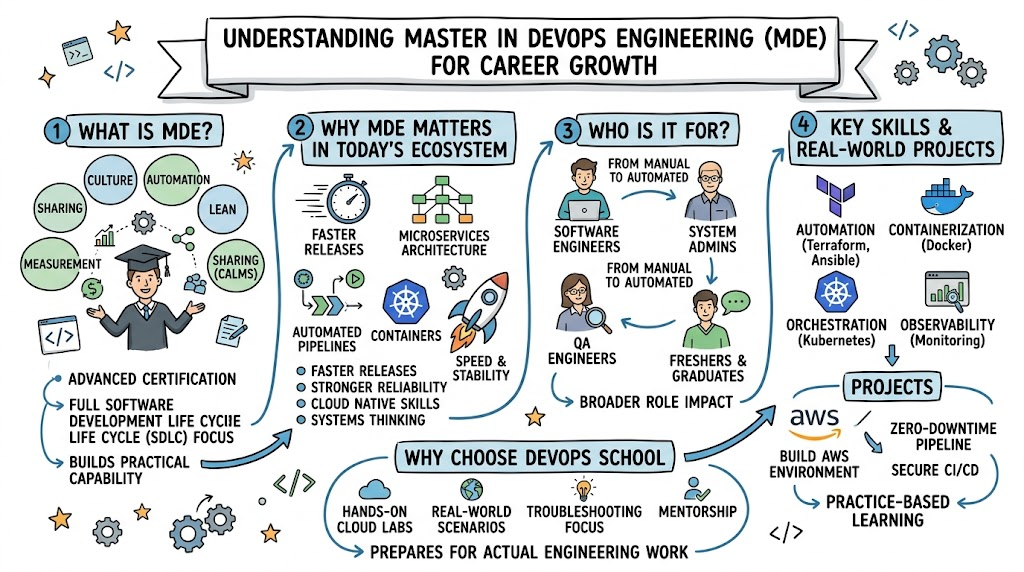
Master in Azure DevOps is a comprehensive professional framework that treats the entire software development and deployment cycle as a single engineering discipline. It exists to provide a standardized, production-focused methodology for shipping software that is secure, compliant, and highly available. This program emphasizes a “production-first” mindset, ensuring that practitioners are prepared to handle the high-concurrency and high-availability demands of modern business.
At its core, this mastery is about shifting from manual, error-prone deployments to repeatable, version-controlled systems. It teaches the practical application of the Azure suite to manage infrastructure as code, ensuring that every deployment is predictable and every change is auditable. By mastering this suite, you transition from a reactive “fix-it” culture to a proactive engineering culture focused on stability and velocity.
Why it Matters in Today’s Software, Cloud, and Automation Ecosystem
The software industry now runs on continuous change. Teams are expected to build, test, release, and improve applications much faster than before, while also keeping systems stable and secure. Cloud platforms have made it easier to scale applications, but they have also increased the need for better automation, smoother deployment processes, and stronger collaboration between development and operations teams. This is where Azure DevOps becomes highly relevant. It supports modern delivery practices by helping teams manage code, automate workflows, reduce manual work, and improve release consistency. Learning these skills is important because companies need professionals who can work effectively in environments driven by speed, reliability, and operational efficiency.
Why Certifications are Important for Engineers and Managers
Certifications are valuable because they give professionals a clear learning direction and help them build skills in a structured and measurable way. For engineers, they show that the person has taken time to understand important tools, methods, and workflows that are commonly used in real projects. They also strengthen a resume and can improve confidence when applying for technical roles or handling more complex responsibilities. For managers, certifications help in identifying capable team members, planning skill development, and creating stronger technical teams. In many cases, a certification acts as a practical signal that someone is serious about professional growth and has validated their knowledge through a recognized path.
Why Choose DevOpsSchool?
DevOpsSchool is a preferred option for many learners because it gives more attention to practical understanding than theoretical discussion alone. The training is designed around real implementation needs, which helps professionals learn how concepts are applied in day-to-day DevOps work. This approach is especially useful for engineers who want job-ready knowledge and for managers who want their teams to gain useful, applicable skills. The programs are usually built in a way that supports gradual learning, better clarity, and stronger confidence in handling real tools and workflows. With a focus on hands-on practice, guided learning, and industry-oriented teaching, DevOpsSchool provides a learning experience that aligns well with professional career goals.
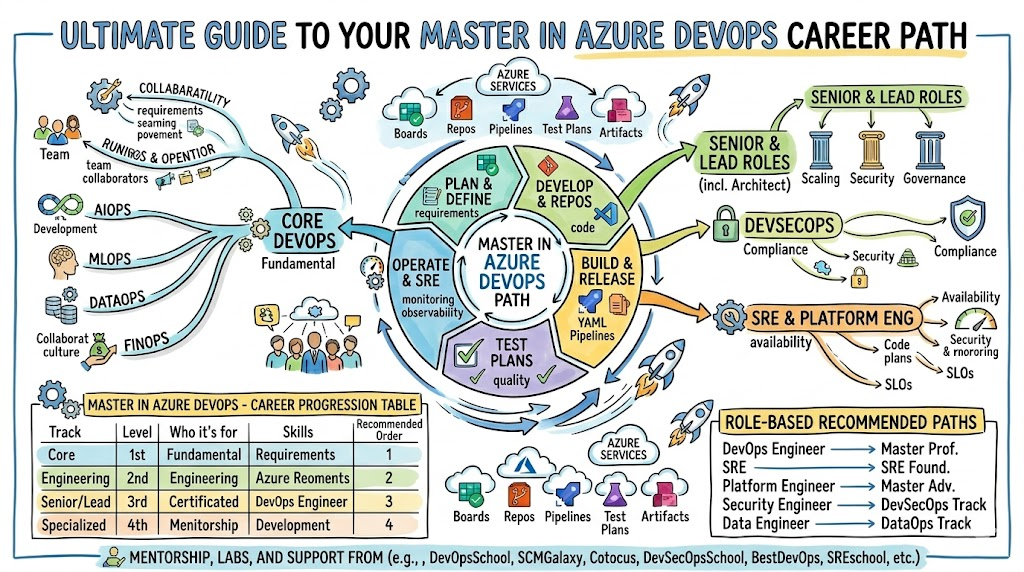
Complete Master in Azure DevOps Certification Table
| Track | Level | Who it’s for | Prerequisites | Skills Covered | Recommended Order |
| Operations | Foundation | Junior Ops/Support | Basic OS knowledge | Boards, Basic CI | 1 |
| Engineering | Professional | DevOps Engineers | Foundation Level | CD, YAML, Docker | 2 |
| Strategy | Advanced | Architects/Leads | Professional Level | Compliance, Scaling | 3 |
| Reliability | Specialized | SRE Professionals | Core DevOps | Observability, SLAs | 4 |
| Data | Specialized | Data Engineers | Core DevOps | Data Pipelines | 4 |
Detailed Guide for Each Master in Azure DevOps Certification
What it is
This certification validates the essential knowledge required to participate in a modern, agile software team. It focuses on the communication and collaborative tools within Azure DevOps that keep projects on track and codebases organized.
Who should take it
This is the ideal starting point for project managers, manual testers, and junior developers who need a formal understanding of how professional software teams organize their daily work.
Skills you’ll gain
- Mastery of the Azure Boards interface for task and bug tracking.
- Basic understanding of Git branching and pull request workflows.
- Ability to navigate and document processes using the Azure Wiki.
Real-world projects you should be able to do
- Setup a project backlog and organize tasks into two-week sprints.
- Create a documentation portal for a team’s onboarding process.
- Configure basic notifications and dashboard widgets for project health.
Preparation plan
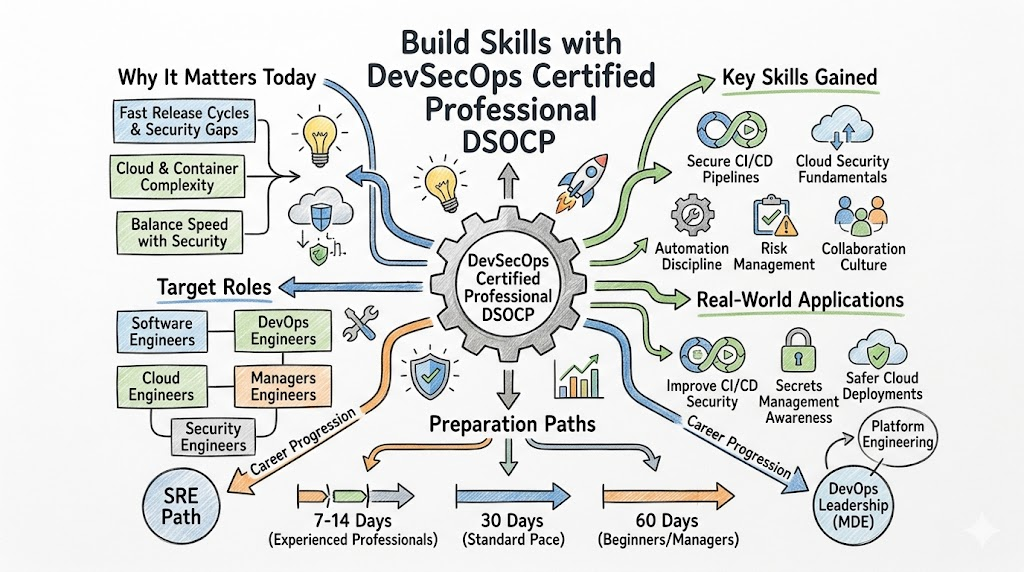
- 7-14 Days: Explore the Azure DevOps user interface and settings.
- 30 Days: Practice linking work items to code commits in a test repo.
- 60 Days: Complete a small project setup from start to finish.
Common mistakes
- Over-complicating the board setup before the team understands the process.
- Using the platform as a simple storage site rather than a collaborative tool.
Best next certification after this
- Same-track: Master in Azure DevOps – Professional
- Cross-track: Certified Site Reliability Engineer – Foundation
- Leadership: Agile Project Management
Choose Your Learning Path
DevOps Path
The DevOps path focuses on the flow of value. You will learn to remove friction from the delivery process, making deployments boring and predictable. This path is ideal for those who want to be the “engine” of the engineering organization, enabling developers to ship code faster and with higher confidence.
DevSecOps Path
The DevSecOps path is about building security into the DNA of the delivery pipeline. You will learn to automate security checks so that they happen every time code is pushed. This path is essential for professionals in finance, health, and government sectors where security is a top priority.
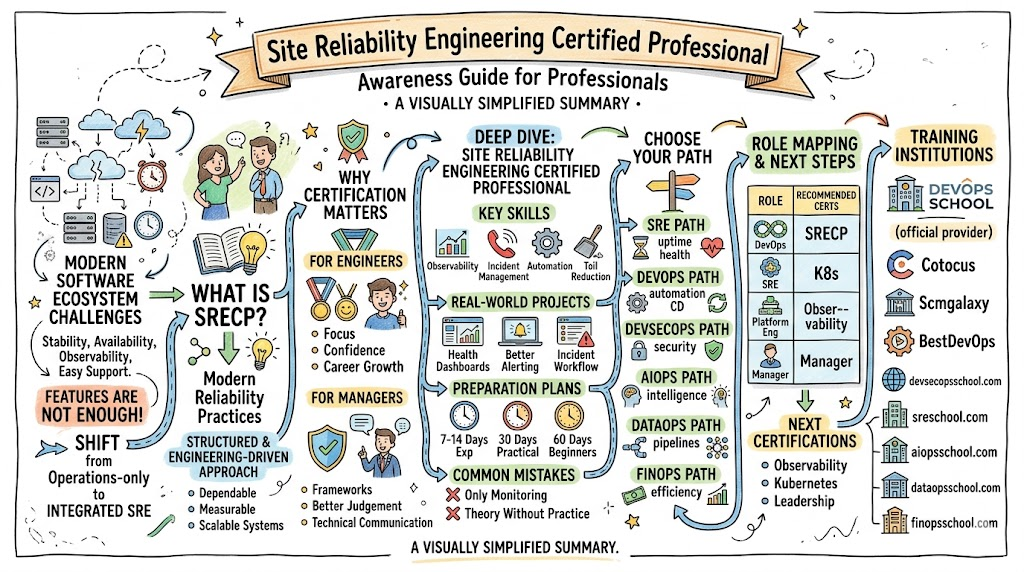
SRE Path
The SRE path is for the system’s “guardians.” You will use engineering principles to keep services running smoothly. This path teaches you how to balance the need for new features with the need for system stability, making it one of the most respected roles in the industry.
AIOps Path
AIOps is the future of automated maintenance. In this path, you will learn to use AI and data science to predict when a system might fail and take action before it affects users. This is a high-level technical path for those who want to work with the next generation of intelligent systems.
MLOps Path
MLOps is designed for those who work with data science teams. You will learn how to bring the discipline of DevOps to machine learning, ensuring that models are trained, tested, and deployed just like regular code. This is a vital path as more companies integrate AI into their products.
DataOps Path
The DataOps path applies DevOps thinking to the world of data engineering. You will learn how to automate the movement and transformation of data, ensuring that your organization has reliable data for making decisions. This path is perfect for data engineers looking to modernize their workflows.
FinOps Path
FinOps is about the economics of the cloud. You will learn how to manage and optimize cloud costs, ensuring that your organization gets the most value from its Azure investment. This path is ideal for senior engineers and managers who are responsible for cloud budgets.
Role → Recommended Master in Azure DevOps Certifications
| Role | Recommended Certifications |
| DevOps Engineer | Master in Azure DevOps – Professional |
| SRE | Certified Site Reliability Engineer – Foundation |
| Platform Engineer | Master in Azure DevOps – Advanced |
| Cloud Engineer | Master in Azure DevOps – Professional |
| Security Engineer | Master in Azure DevOps – DevSecOps Track |
| Data Engineer | Master in Azure DevOps – DataOps Track |
| FinOps Practitioner | Master in Azure DevOps – FinOps Track |
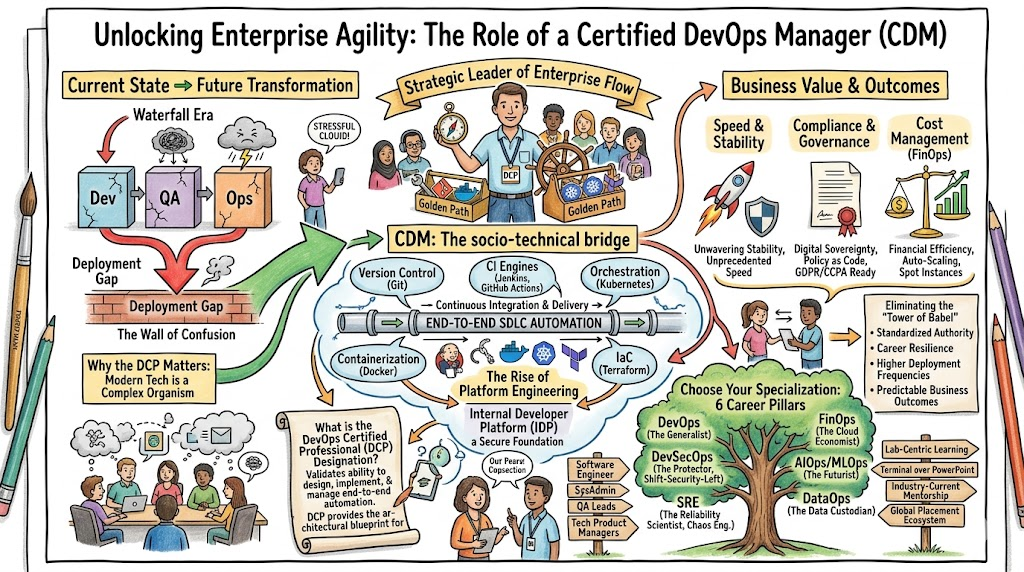
| Engineering Manager | Master in Azure DevOps – Foundation & Leadership |
Next Certifications to Take After Master in Azure DevOps
Same Track Progression
After the Professional and Advanced levels, the next step is to lead global engineering standards. This involves mastering the governance of multiple Azure organizations, setting up global networking for pipelines, and creating shared toolsets for thousands of developers. You will transition from being an engineer to being a policy-maker for the entire technology stack.
Cross-Track Expansion
To broaden your impact, consider expanding into cloud architecture or specialized security. Understanding the infrastructure that your pipelines deploy into allows you to build more resilient systems. This broader perspective is what separates a senior engineer from a principal architect who can design entire business systems.
Leadership & Management Track
For those aiming for management, the goal is to use technical knowledge to drive business outcomes. Certifications in technical leadership and agile management will help you lead teams, manage budgets, and align technology with the company’s long-term goals. You will learn to speak both “code” and “business.”
Training & Certification Support Providers for Master in Azure DevOps
- DevOpsSchool
DevOpsSchool offers a practical approach that bridges the gap between basic theory and real-world execution. Their training focuses on the actual tools used in the industry, providing students with the hands-on experience needed to succeed in an enterprise environment.
- Cotocus
Cotocus specializes in intensive technical bootcamps for modern cloud technologies. Their curriculum is designed for professionals who need deep technical knowledge and practical skills to manage complex Azure and DevOps infrastructures.
- Scmgalaxy
Scmgalaxy is a leading community resource for anyone involved in software delivery. They provide an extensive range of tutorials, documentation, and expert advice to help professionals navigate their certification and career journey.
- BestDevOps
BestDevOps focuses on delivering job-ready training that meets the current demands of the global tech market. Their courses are built on real-world scenarios, ensuring that graduates are ready to contribute to their teams from day one.
- Devsecopsschool
Devsecopsschool is dedicated to the integration of security into the DevOps workflow. They offer specialized training that helps professionals build secure, compliant, and automated pipelines within the Azure ecosystem.
- Sreschool
Sreschool focuses on the disciplines of reliability and performance. Their training programs are designed for engineers who want to specialize in keeping complex systems stable and available using modern SRE methodologies.
- Aiopsschool
Aiopsschool provides training on the future of IT operations, showing how AI and machine learning can be used to automate and optimize the DevOps lifecycle. This training is essential for staying at the cutting edge of the industry.
- Dataopsschool
Dataopsschool teaches data professionals how to apply DevOps principles to their data pipelines. This improves the speed and quality of data delivery, ensuring that organizations can rely on their data for critical decisions.
- Finopsschool
Finopsschool addresses the financial challenges of the cloud. Their training helps engineers and managers optimize their cloud spending, ensuring that technical innovation remains cost-effective and sustainable.
Frequently Asked Questions (General)
How much time is required to prepare for the Professional track?
Most professionals find that spending 10-15 hours a week over three months allows them to thoroughly master the lab environments and theoretical concepts.
Is Azure DevOps a better career choice than AWS DevOps?
Both are high in demand, but Azure DevOps is often preferred by large enterprises heavily invested in Microsoft’s ecosystem, offering deep integration and simplified management.
Do I need to be an expert in Git to start?
No, the Foundation level covers basic version control. However, a willingness to learn Git-flow and branching strategies is essential for the higher-level engineering tracks.
Can I use Azure DevOps with open-source tools like Jenkins?
Yes, the platform is extremely flexible. You can trigger Jenkins builds from Azure DevOps or use Azure Pipelines to deploy code built in other CI systems.
Is this certification recognized by Fortune 500 companies?
Absolutely. Many major enterprises require these certifications for their senior cloud roles because they validate hands-on engineering capability rather than just theory.
How do I access the lab environments?
Training providers like DevOpsSchool provide dedicated lab access. You can also use a personal Azure account with the “Free Tier” to practice many of the core services.
Is there any prerequisite for the Advanced level?
Yes, you must have achieved the Professional certification and have significant hands-on experience managing production-grade cloud deployments.
How does this certification help in the global job market?
It proves your competency in the Microsoft Cloud ecosystem, which is used by millions of organizations globally, making your skills transferable across countries.
Can I specialize in just one area like security?
While the Master program is broad, it allows you to specialize in DevSecOps or SRE tracks after you have established your core DevOps foundation.
Is the training available online?
Yes, most authorized training partners offer flexible online schedules, including live instructor-led sessions and self-paced video modules.
How often is the curriculum updated?
The curriculum is reviewed quarterly to ensure it reflects the latest updates to the Azure platform, including new pipeline features and security tools.
Is there any career support provided?
Most leading institutions offer comprehensive career support, including resume optimization, interview coaching, and access to hiring partners in the tech industry.
FAQs on Master in Azure DevOps
What is “YAML as Code” in Azure DevOps?
This is the practice of defining your entire build and release process in a text file within your repository, allowing for version control and peer reviews of your pipelines.
How do “Self-Hosted Agents” differ from Microsoft-hosted ones?
Microsoft-hosted agents are managed by Azure, while self-hosted agents run on your own infrastructure, giving you more control over the software and network access.
What is the purpose of “Variable Groups” in the library?
Variable groups allow you to store and share configurations and secrets across multiple pipelines, reducing duplication and improving security management.
Can I use Azure DevOps for containerized applications?
Yes, it has native integrations for Docker and Azure Kubernetes Service (AKS), allowing you to build, scan, and deploy containers at scale.
What are “Deployment Gates” in a release pipeline?
These are automated checks—like monitoring alerts or health probes—that must pass before a release is allowed to move to the next environment, like Production.
How does Azure Boards help with Agile tracking?
It provides customizable Kanban boards, sprint backlogs, and velocity charts that allow teams to visualize progress and identify bottlenecks in real-time.
What is the role of Azure Artifacts?
It acts as a private package repository for your team, allowing you to host and version your own NuGet, npm, or Python packages securely.
How do I secure my Azure DevOps organization?
Security is handled through Microsoft Entra ID integration, fine-grained permissions, and branch policies that prevent unauthorized code from being merged.
Conclusion
Master in Azure DevOps is a highly practical certification for professionals who want to build strong, real-world skills in cloud-based DevOps practices. It goes beyond theory and focuses on how modern software systems are actually built, deployed, and maintained using Azure tools and automation. If you are aiming to work in environments that demand continuous delivery, scalable infrastructure, and reliable systems, this certification provides a clear and structured learning path. For engineers, it helps in gaining confidence, improving problem-solving ability, and handling production-level challenges more effectively. For managers, it offers better visibility into team capabilities and helps in making informed technical decisions. Overall, it is a valuable step for anyone looking to grow in DevOps, cloud engineering, or platform roles, especially if your goal is long-term career stability and progression in a competitive technology landscape.astery is rigorous because the responsibilities of a senior cloud engineer are significant. However, the career rewards—both in terms of influence and financial compensation—are equally high. If you are ready to move from being a technician to a technical architect who designs the systems of the future, then this certification is absolutely worth your time and effort.